


Quick Answer: Buy a T-money card at a convenience store, load it with cash, and tap it at the gate when you enter and when you exit. A ride costs about ₩1,550. Staying 3+ days and riding a lot? Compare the Climate Card pass.
Fares and card rules change, so confirm at the station if a number matters to you.
The Seoul subway is clean, fast, and cheap. It’s also where first-timers freeze at the gate with a foreign credit card in hand. I ride it every day, and the same few things trip people up: which card to buy, how to load it, and why the machine rejects your Visa.
Your Options at a Glance
| Option | Cost | Best for | Catch |
|---|---|---|---|
| T-money card | About ₩2,500-4,000 for the card, then load money | Most visitors | The card itself isn’t refundable |
| Single-journey ticket | ₩1,650 base fare plus a ₩500 refundable deposit | One or two rides | You must return it for the deposit |
| Climate Card short-term pass | ₩5,000 (1 day) to ₩20,000 (7 days), plus a ₩3,000 card fee | Heavy riders staying several days | Doesn’t cover the AREX Express, the Incheon Airport stretch of AREX, or the Sinbundang Line |
| T-money in iPhone Wallet | Free to add, load money | iPhone users | Top-up rules depend on your card brand |
Buy a T-money Card
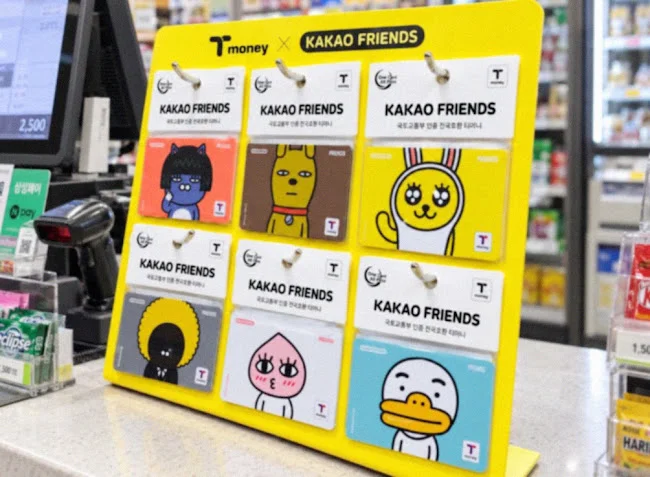
Every convenience store sells them, including CU, GS25, and 7-Eleven. Look for the rack near the register. Designs vary, and character cards cost a bit more than plain ones. The Kakao Friends cards below are everywhere.
Load It: Bring Cash
This is the step that catches people. You can top up at convenience stores or at the machines in the station. Tell the clerk “chungjeon juseyo” (charge, please) and hand over cash.

Warning: At the machine I used, the payment screen said foreign cards may not be accepted, and that only domestic cards in Samsung Pay or Apple Pay work. Some sources say newer machines take international cards, but I wouldn’t count on it. Carry a few thousand won in cash.

How to Ride
- Tap your card on the gate reader when you enter.
- Follow the line color and number to your platform.
- Tap again when you exit. If you skip it, your next ride can get charged extra.

Read the Station Signs
Each station has a number. The first digit is the line, so 222 Gangnam is on Line 2. Line colors help too: green is Line 2, blue is Line 4. Match the number on the sign to the number on your map app and you’ll never ride the wrong way.


Transfers
Follow the colored circles on the floor and the signs overhead. Transfers inside the system don’t add a base fare. A bus-to-subway transfer within 30 minutes also doesn’t add a base fare.

What It Costs
Seoul has one of the most developed subway systems in the world, and it’s cheap by big-city standards. Transfers are where it really shines. In Tokyo, switching between rail companies often means paying a new fare. In Seoul, changing lines doesn’t cost extra. Longer trips do add a small distance charge, but it stays affordable.
A ride on a T-money card is about ₩1,550. Long trips add ₩100 for every extra 5 km after the first 10 km. A single-journey ticket costs ₩1,650, plus a ₩500 deposit you get back at a refund machine.
Is the Climate Card Worth It?
The Climate Card short-term pass gives unlimited rides on the Seoul subway and Seoul city buses for a set number of days.
| Pass | Price | Worth it if you ride about |
|---|---|---|
| 1 day | ₩5,000 | 4+ times in a day |
| 3 days | ₩10,000 | 7+ times in total |
| 5 days | ₩15,000 | 10+ times in total |
| 7 days | ₩20,000 | 13+ times in total |
Add the one-time ₩3,000 card fee. In my experience, the easiest place to buy one is the station staff office, usually right next to the ticket gates. Some stations also sell it at the ticket machines and nearby convenience stores.
Pro-Tip: If the machine won’t sell you a Climate Card or rejects your payment, don’t keep trying. Walk to the station staff office by the gates and ask. Staff deal with this all day.


Pro-Tip: The pass doesn’t cover the Airport Railroad (AREX) or the Sinbundang Line. If you’re arriving from Incheon, buy that ticket separately. My Incheon to Seoul guide compares your options, and you can book the AREX Express ticket on Klook.
iPhone Users: T-money in Apple Wallet
You can add T-money to Apple Wallet and tap your phone at the gate. To top it up with a foreign card, use the Tmoney app, not the Wallet app. As of March 2026 it takes Mastercard, Amex, and UnionPay, but not Visa. Test it before you rely on it.

Not sure which card fits your trip? See WOWPASS vs NAMANE vs Discover Seoul Pass for a side-by-side look at the options.
Apps to Install
- Naver Map: best for real-time train times and which car to board.
- KakaoMap: a solid backup with clear English labels.
- Google Maps: fine for rough routes, but weak for walking directions in Korea. See Does Google Maps Work in Korea?
Apps need data. Set up an eSIM before you fly: best eSIM for Korea. After the last train, you’ll want a taxi app, so read Kakao T vs Uber.
Frequently Asked Questions
Can I use a foreign credit card on the Seoul subway?
No. Foreign cards, including Visa and Mastercard, do not work at the subway gates. You need a Korean transit card such as T-money. You can also buy a single-journey ticket at the station counter.
How much is a subway ride in Seoul?
A ride on a T-money card is about 1,550 won for the base fare, with a small extra charge for longer distances. Single-journey tickets cost 1,650 won plus a 500 won refundable deposit.
Is the Climate Card worth it for tourists?
It can be if you ride often, for example about 4 or more times a day on a 1-day pass. You can usually buy it at the station staff office next to the gates. It does not cover the Airport Railroad or the Sinbundang Line.
For more on paying in Korea, read our payment guide. If you are arriving at Incheon, our airport transfer guide covers the AREX train and other options.
Mistakes to Avoid
- Forgetting to tap out at the exit gate.
- Arriving with no cash and only a foreign card.
- Buying a Climate Card for a trip with only a few rides.
- Riding at 8-9 a.m. or 6-7 p.m. with big luggage. It’s packed.
- Missing the last train. Times vary by line and direction, so check your app.
Disclosure: This post contains affiliate links. If you book through them, I may earn a small commission at no extra cost to you.
Disclaimer: This article is for general information only. Visa rules, K-ETA requirements, exchange rates, fares, and opening hours change often. Check official sources before you travel, such as the Korean embassy or consulate in your country, the Korea Immigration Service, or the official app or operator. We are not responsible for decisions made from this information.